Starting in 2026, Singapore will begin stopping high-risk travelers before they even enter the country. New No-Boarding Directives (NBDs) will empower immigration authorities to instruct airlines and shipping companies not to allow individuals deemed a threat to health, safety, or immigration laws to board.
Airlines that ignore these directives could face penalties of approximately $7,700.75. Here’s what the new policy means and why it matters for global travelers.
Table of Contents
No-Boarding Directives: What to Know
The No-Boarding policy results from the Immigration (Amendment) Act, which came into force on 31 December 2024. Under the new regulations:
- Airlines must comply with No-Boarding Directives beginning in 2026
- Shipping operators will be required to comply by 2028
- Land checkpoints (e.g., car and bus crossings from Malaysia) are currently excluded but may be included in future expansions
The focus is to intercept high-risk individuals before they land, using predictive security tools, advanced data analysis, and biometric profiling.
Access Refusals on the Rise
In just the first half of the year, Singapore’s Immigration and Checkpoints Authority (ICA) reported a 43% increase in foreign nationals denied entry, compared to the same period the previous year.
Should you find this piece engaging, we kindly invite you to explore the wealth of content in our other articles:
- Language Level Required to Apply For Canadian Citizenship
- Canada Immigration Paradox of Prospective and Restricted Opportunities
- What You Need to Know About Canada Immigration Work Permit Visa
- Migration to Canada from Serbia: Four Pathways, Provisions, and Duration
- Saudi Arabia’s Qiwa Platform Includes 60-Day Grace Period for International Employees
Although ICA hasn’t released exact profiles, typical cases likely include:
- Individuals previously deported or banned for criminal activity
- Persons flagged as security or public health risks
- Travelers with links to extremist groups or organized crime
This is not about restricting all travelers—it’s about smarter, faster risk detection.
More Travelers, Limited Manpower: Enter Biometrics
With over 230 million travelers passing through Singapore’s checkpoints in the past year (up from 197 million in 2015), ICA must adapt. Rather than expanding staff endlessly, they’re investing in smart technologies.
Key infrastructure upgrades include:
- Changi Airport Terminal 5 (targeted for mid-2030s)
- Singapore–Johor Bahru Rapid Transit System (RTS), launching by December 2026
- Woodlands Checkpoint Expansion, planned within 10–15 years
Passport-Free Immigration Is Already Here
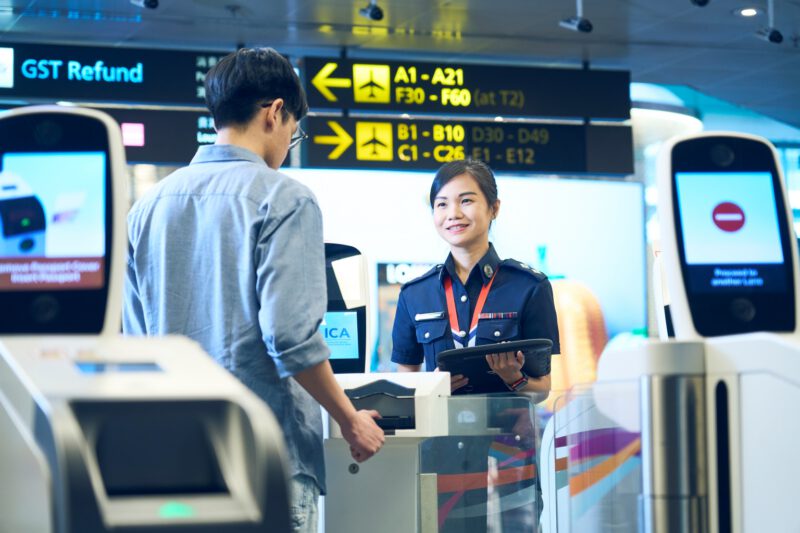
Under ICA’s New Clearance Concept (NCC), fully implemented since 2019, travelers can now enter Singapore without showing a physical passport.
- Air and sea travelers are cleared via facial or iris biometrics
- Land travelers use QR codes, with full biometric rollout imminent
As of 30 June 2025, more than 93 million travelers have cleared immigration using passport-free methods—and the number continues to grow.
What This Means for Cross-Border Travelers
Many regional travelers arrive in Singapore via Malaysia using land routes, which currently have fewer pre-screening requirements. However, ICA aims to extend No-Boarding-style oversight to these land pathways as well.
While rollout may take time, travelers should expect:
- Increased data sharing between transport operators and ICA
- Higher levels of pre-clearance for land entries
- Tighter scrutiny even for seemingly low-risk travel routes
Conclusion
Singapore is not building a fortress—it’s building a smarter, more adaptive border system. Through real-time intervention, biometric technology, and advanced risk profiling, Singapore aims to streamline immigration for law-abiding travelers while preemptively stopping potential threats before they arrive.